NIS2 Article 21 · Operational Resilience
How prepared are you for NIS2 compliance?
Benchmark your organization's cybersecurity risk management posture across 5 critical Article 21 domains — and get a detailed report of your NIS2 readiness in under 5 minutes.
- 1Governance & AccountabilityHow resilience controls are enforced, owned, and tested across your organization.
- 2Incident Detection & ResponseYour ability to detect, contain, and recover from storage-layer incidents.
- 3Business Continuity & RecoveryThe depth and reliability of recovery capabilities under real-world stress conditions.
- 4Infrastructure & Supply-ChainHardware dependency, procurement exposure, and capacity cost management.
- 5Operational AuditabilityYour readiness to provide regulator-grade evidence of resilience controls.
Your results are ready
We've analyzed your responses across all 5 domains. Add your details to unlock your personalized NIS2 resilience report.
- Your overall maturity scoreA single 0–100 rating of your NIS2 Article 21 resilience posture.
- Domain-by-domain breakdownSee how you performed across each of the 5 resilience domains.
- Where you standYour position across the 5 maturity levels, from Reactive to Verifiable.
- Prioritized recommendationsA ranked, actionable roadmap to address your highest-priority areas first.
How does your organization currently demonstrate that storage resilience controls are actively enforced rather than only documented?
Who is operationally accountable if a storage-related incident impacts service continuity or regulatory reporting obligations?
How frequently are storage recovery procedures tested under realistic production conditions?
Can you prove that recovery points cannot be modified or deleted outside approved retention policies?
How quickly can your team detect storage-layer anomalies before applications are impacted?
What visibility do you currently have into degraded redundancy states or partial failure conditions?
How is incident evidence preserved during or after a ransomware event?
During a storage incident, how much of the recovery process still depends on manual operator actions?
Have you validated recovery behaviour during simultaneous infrastructure stress conditions (e.g., node failure plus rebuild plus peak workload)?
How confident are you that your current recovery objectives remain achievable during degraded infrastructure states?
Are your recovery workflows deterministic and repeatable — or do they depend on specific team expertise?
How do you ensure that resilience testing reflects actual operational workloads rather than isolated lab conditions?
To what extent does your resilience strategy depend on specific hardware vendors or hardware availability?
How exposed is your organization to current storage hardware lead-time and pricing volatility?
Can your organization extend infrastructure lifecycle safely while maintaining resilience requirements?
How do you balance increasing resilience requirements with rapidly rising storage capacity costs?
How do you currently demonstrate that resilience controls remain effective after infrastructure changes or upgrades?
Can your monitoring systems provide regulator-ready operational evidence during post-incident reviews?
How do you ensure storage recovery integrity in the event of malicious insider activity or compromised administrator credentials?
If a regulator asked tomorrow for evidence that your storage recovery architecture is resilient, repeatable, and tamper-resistant, what evidence would you provide first?
Prepared for·
Your report will also arrive by email shortly.
We couldn't submit your details. Please try again or contact us.
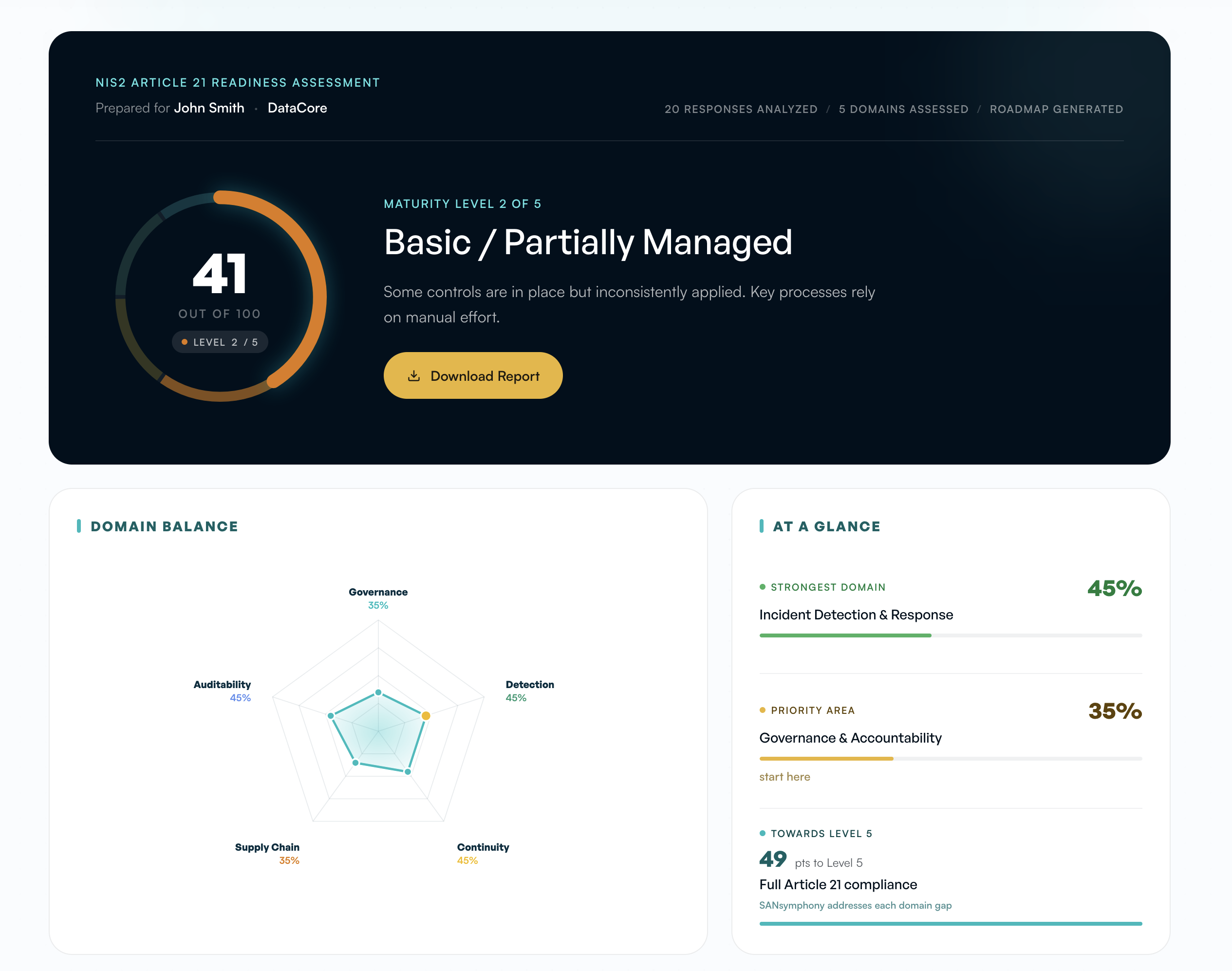
Domain balance
At a glance
Where you stand
Level 5 is the NIS2 compliance target. You'repoints from full compliance — SANsymphony is built to address every storage-layer gap on the path to full Article 21 compliance.
You're at the highest maturity level. Focus now shifts tosustaining continuous validation and audit-ready evidence.
Prioritized recommendations
Ready to improve your NIS2 compliance posture with DataCore?
DataCore SANsymphony helps organizations address NIS2 Article 21 requirements with cyber-resilient infrastructure, immutable data protection, and enterprise-grade business continuity and disaster recovery capabilities. Improve your ability to prevent, withstand, and recover from disruption while generating the audit-ready evidence needed to demonstrate compliance with NIS2 mandates.
Your report will also arrive by email shortly.
We couldn't submit your details. Please try again or contact us.
Full-featured trial · No credit card required